For years, remote work was treated as a workplace benefit. Companies introduced work-from-home policies, invested in collaboration tools, and allowed employees to operate from different cities or countries. The primary question was simple: Can people work effectively without being in the same office?
That question is no longer enough. As artificial intelligence, skills shortages, global competition and changing employee expectations reshape the workplace, business leaders are facing a more strategic challenge: How can an organisation access the right talent, wherever it exists, and deploy it when the business needs it?
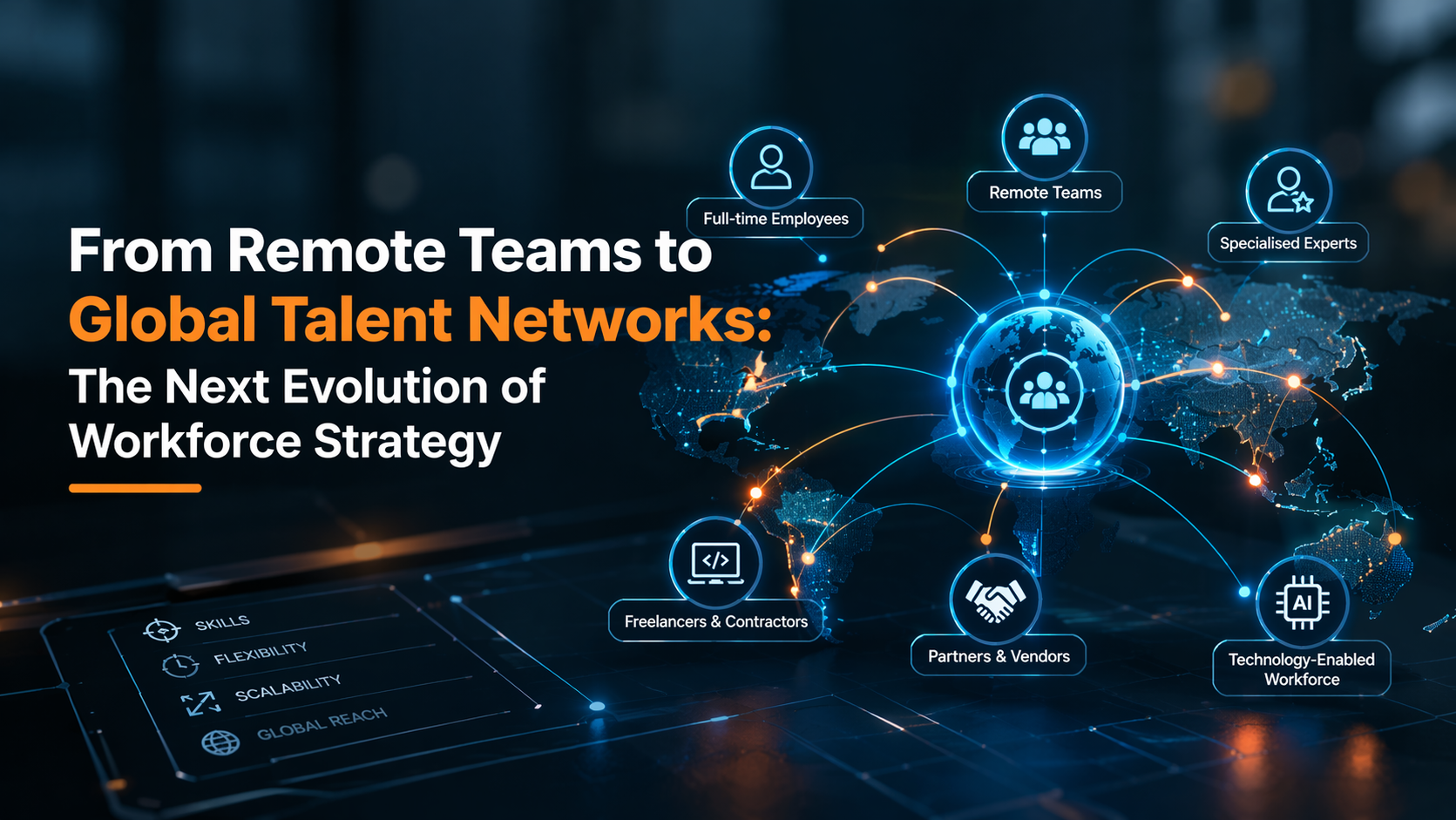
This is where the idea of global talent networks is emerging. It goes beyond remote teams. Instead of building a workforce around permanent roles, office locations or traditional reporting structures, companies are beginning to combine full-time employees, international teams, specialised experts, technology-enabled workers and external partners.
The objective is not simply to reduce employment costs. It is to build a workforce that can respond to changing markets, technologies and business priorities.
Remote Work Was the Beginning, Not the Final Model
Remote work proved that many roles do not require employees to be physically present in the same location. McKinsey’s research on the future of remote work found that 20–25% of the workforce in advanced economies could potentially work from home three to five days a week, depending on the role and industry. However, the research also highlights that remote work is not equally suitable for every occupation or task.
This distinction matters. A software developer, financial analyst or digital marketing specialist may be able to work remotely with the right infrastructure. A manufacturing engineer, laboratory technician or facilities manager may require physical access to equipment and locations.
Therefore, the future of workforce strategy is unlikely to be entirely remote or entirely office-based. It will be task-based, capability-led and business-dependent. The question leaders should ask is not, “Should we bring everyone back to the office?” It is, “Which work needs to happen where, by whom, and under what operating model?”
The Talent Market Is Becoming a Skills Market
Traditional workforce planning often begins with job titles. A company may decide that it needs ten engineers, a marketing manager or a regional sales team. But job titles can hide the real business requirement.
A company may not need ten permanent engineers. It may need expertise in embedded systems for six months, cybersecurity support for a product launch, or a specialised research team before entering a new market.
The World Economic Forum’s Future of Jobs Report 2025, based on input from more than 1,000 employers representing over 14 million workers across 55 economies, estimates that by 2030, 170 million new jobs could be created while 92 million jobs could be displaced. This would result in a net increase of 78 million jobs. The report also estimates that approximately 59 out of every 100 workers may require training by 2030.
These figures point to a significant shift. The challenge will not simply be finding more people. It will be finding people with relevant and continuously evolving capabilities.
For business leaders, this means workforce planning must move from headcount management to skills and capability management. Organisations need to understand which capabilities they already possess, which skills are becoming obsolete, what expertise will be required over the next 12–24 months, and which capabilities should be developed internally or sourced externally. This is the foundation of a global talent network.
Why Global Talent Networks Are Gaining Momentum
A global talent network connects an organisation to capabilities across locations, employment models and professional communities. It may include permanent employees in core markets, dedicated teams operating from international locations, independent specialists, research and engineering partners, project-based contractors, technology-enabled workers and local partners supporting market entry.
The organisation does not necessarily manage every contributor in the same way. Instead, it creates a structure for deciding where each capability should come from and how it should be integrated into business operations.
This approach can be particularly relevant for companies expanding into new countries. For example, a European technology company entering India may require engineering talent, local vendor relationships, regulatory knowledge, payroll support and programme management. Hiring a country manager alone may not solve these operational requirements.
A coordinated talent and execution network may provide access to several capabilities without requiring the company to build every function from scratch.
AI Will Change Workforce Design—Not Eliminate the Need for People
Artificial intelligence is adding another layer to workforce planning. The World Economic Forum reports that 86% of employers expect AI and information-processing technologies to transform their businesses by 2030. The same research identifies AI and big data, networks and cybersecurity, and technological literacy among the fastest-growing skill areas.
AI will automate some tasks, but it will also create demand for new combinations of human and technical capabilities.
Consider a product development team. In the past, it may have required researchers, developers, testers and documentation specialists. With AI-enabled tools, the composition of that team may change. Some repetitive activities could be automated, while demand increases for product judgement, domain expertise, quality control, cybersecurity and responsible technology governance.
Gartner has warned that organisations without a comprehensive, people-centred AI strategy could lose top AI talent to competitors by 2027. Its 2026 research involved 12,004 employees and managers across 40 countries.
The message for leaders is practical: AI adoption cannot be separated from workforce design. Companies must determine which tasks should be automated, where human judgement is essential, what new skills are required, how employees will be trained, and how performance will be measured.
Buying AI tools without redesigning work may increase technology expenditure without delivering corresponding business value.
The Operating Challenges Leaders Cannot Ignore
Global talent networks create opportunities, but they also introduce complexity. Employing or engaging people across borders can involve employment law, taxation, social security, contracts, data protection and cross-border payments. A model that works in one country may not be suitable in another, so organisations need appropriate legal and operational structures before scaling international talent.
Communication and time zones present another challenge. A distributed workforce does not automatically become a connected workforce. Companies need clear documentation, defined ownership, shared performance expectations and carefully designed meeting practices. Without these, teams may spend more time coordinating than executing.
Quality and accountability must also be deliberately designed. External specialists and international teams need measurable deliverables, clear service-level expectations, review mechanisms, data access controls and escalation processes.
Culture is equally important. It cannot depend entirely on physical proximity. It must be reinforced through leadership behaviour, communication, onboarding and consistent decision-making.
Deloitte’s research on the future of work highlights the need for organisations to manage tensions such as stability versus agility and automation versus augmentation, rather than treating them as simple either-or choices.
The Business Benefits of Global Talent Networks
A well-designed global talent network can deliver benefits beyond recruitment flexibility. The first is access to specialised talent. Companies are no longer restricted to the skills available in their immediate geographic market. They can access engineering, research, technology, marketing and operational expertise from locations where those capabilities are more readily available.
The second benefit is greater workforce scalability. Businesses can expand a project team when demand increases and adjust its composition when the project moves into a different phase. This can be particularly valuable for companies managing product development, technology implementation or market-entry programmes that do not require the same capabilities throughout their lifecycle.
Global talent networks can also improve speed to market. Instead of spending months establishing every internal function in a new geography, companies can work with established local teams and partners that understand the talent market, regulatory environment and operational requirements. The time saved can be redirected towards product development, customer acquisition and business execution.
Another advantage is operational resilience. Dependence on a single location or talent pool can expose organisations to hiring shortages, local disruptions and rising operating costs. A distributed network, when supported by strong governance and communication, can provide access to alternative capabilities and locations.
There may also be opportunities for cost optimisation, but this should not be reduced to hiring the lowest-cost workforce. The more meaningful question is whether the organisation can achieve the required quality, delivery speed and business outcomes at an efficient total cost. Factors such as productivity, management overhead, compliance, employee retention and rework must be considered alongside salary costs.
Finally, global talent networks can support innovation and market understanding. Teams working across different countries and professional environments may bring new perspectives, local customer insights and specialised knowledge. For organisations expanding internationally, this combination of global expertise and local execution can help bridge the gap between strategic intent and practical implementation.
The benefit is not simply having people in different locations. It is creating a workforce model that gives the business access to the right capabilities, at the right time, with clear accountability for outcomes.
What Business Leaders Should Do Next
Organisations preparing for the next phase of workforce strategy can begin by mapping capabilities rather than focusing only on positions. Leaders should identify the skills required to deliver strategic priorities and distinguish permanent workforce requirements from project-based needs.
The next step is to segment work by location and complexity. Businesses need to determine which responsibilities require physical presence, which can be delivered remotely, and which benefit from local market expertise.
Companies should also consider a blended talent model that combines internal employees with specialist partners, international teams and project-based experts where appropriate. However, this model must be supported by strong governance, including compliance processes, data security, communication protocols, ownership structures and performance measures.
Most importantly, workforce decisions should be connected to business outcomes. The success of a talent model should be assessed through indicators such as speed to market, project delivery, capability access, operating efficiency, innovation and revenue contribution—not simply the number of people hired.
The Ufinity Approach
For global companies exploring India, building a talent network requires more than recruitment. It requires an operating partner that understands how talent, technology, compliance and execution fit together.
Ufinity helps organisations build and manage their India-side capabilities, including research and engineering talent, technology programme support, sourcing and localisation, trade and regulatory compliance, and on-ground programme management.
This is particularly relevant for businesses entering India for the first time or expanding an existing technology, hardware, engineering or advanced manufacturing programme.
The organisation may bring its global product knowledge, technical standards and intellectual property. The local execution model must then address practical requirements such as talent sourcing, vendor development, facilities, logistics, regulatory processes and programme coordination.
That is where a global talent network becomes more than a hiring strategy. It becomes an extension of the company’s operating model.
The future of work will not be defined by whether employees sit in offices or work from home. It will be defined by how effectively organisations combine people, capabilities, technology and local execution to deliver business outcomes across markets.
Companies that begin building this capability now will be better positioned to respond when the next skill shortage, market expansion opportunity or technology shift arrives.
—-
Sources
- World Economic Forum — The Future of Jobs Report 2025.
- McKinsey & Company — The Future of Work research.
- Gartner — Research on people-centric AI strategies and talent retention, 2026.
- Deloitte — 2025 Global Human Capital Trends.
Note: Economic and investment figures are published estimates or forecasts, not guarantees of future performance. Strategic projections in this article are editorial analysis based on the cited trends.