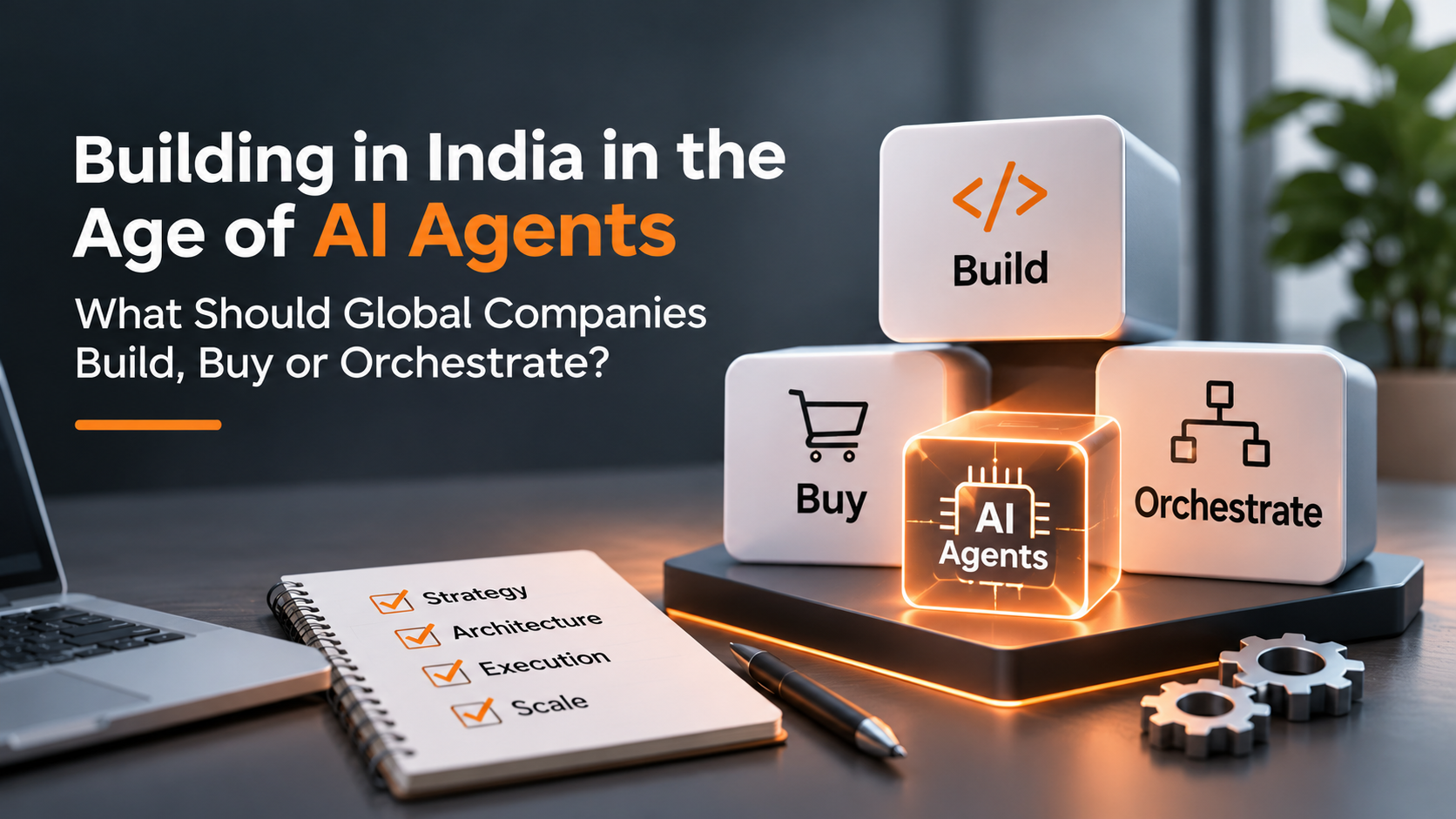
For decades, one of the most familiar questions in enterprise technology was deceptively simple: Should we build it or buy it? The answer generally depended on cost, internal engineering capability, speed to market, control and strategic importance. Companies built technology when it created competitive differentiation and bought it when the capability had become sufficiently standardised. That logic shaped enterprise software procurement for years.
Artificial intelligence is beginning to change the equation. The rise of AI agents, agentic workflows and AI-assisted software development means companies can now buy access to powerful models, build specialised applications with smaller teams, connect third-party agents to proprietary systems and coordinate multiple AI systems around a single business process. The result is a technology environment in which the final capability may be neither entirely bought nor entirely built.
It is increasingly assembled and orchestrated. That makes the traditional build-versus-buy question incomplete. The more relevant strategic question for technology leaders is becoming: What should we buy, what should we build and what should we orchestrate?
The scale of the shift is already visible in technology spending. Gartner forecasts worldwide AI spending of approximately $2.7 trillion in 2026, a 49.5% increase over 2025. Gartner also projects an AI services opportunity of approximately $1.2 trillion by 2030, reflecting growing demand for implementation, integration, transformation and managed services.
Yet adoption is moving faster than measurable business value. McKinsey’s 2026 research shows that 40% of respondents from organisations with more than $1 billion in revenue report scaling AI agents, up from 27% a year earlier. At the same time, organisations are still grappling with the cost and operational implications of AI.
The next phase of enterprise AI will therefore not be defined simply by how much organisations spend on AI. It will be defined by whether they make better decisions about ownership, architecture, economics and execution.
The Build-versus-Buy Model Is Breaking Down
The traditional framework worked particularly well when software categories were relatively stable. A company could buy an ERP system, CRM platform or collaboration suite and expect the underlying product category to remain recognisable for years. If the technology represented a unique competitive capability, building internally made sense. AI is making that boundary much less distinct.
An enterprise might buy access to a foundation model but build its own application layer. It could purchase an enterprise platform while developing proprietary agents on top of it. It might use AI coding agents to develop internal software while buying cloud infrastructure, security and data services from external providers.
This is creating a more modular technology landscape. The strategic objective is no longer to own every layer of the technology stack. It is to understand which layers create competitive advantage, which create dependency, which create risk and which can be treated as infrastructure. That leads to the first principle: buy what is becoming infrastructure.
For most enterprises, foundation-model access, cloud infrastructure, identity management, standard security capabilities, generic enterprise connectors and general-purpose productivity tools are unlikely to be sources of differentiation. Buying these capabilities can allow internal teams to focus their resources on technology that is closer to the company’s intellectual property and business model.
But buying AI capabilities requires more scrutiny than conventional software procurement. Data ownership, portability, security, model dependency, usage-based costs, auditability and exit options become increasingly important once AI is embedded into core workflows.
The objective is therefore not simply to buy technology. It is to buy without surrendering strategic flexibility.
Build What Becomes Proprietary
The economics of building are changing at the same time. AI-assisted development is reducing the time and effort required to create software. McKinsey’s 2026 research found that 32% of respondents said their organisations had decided against purchasing at least one software product or feature because they could build the functionality internally using agentic coding tools.
This does not mean companies should start rebuilding every commercial application they use. It means the threshold at which internal development becomes economically viable is changing.
The strongest case for building will increasingly be found where software contains proprietary business knowledge, unique workflows, specialised data or customer-specific logic. A company may choose to build an internal decision system, domain-specific AI agent, proprietary data product or specialised workflow because those capabilities become more valuable as the organisation grows.
The important question is therefore not simply, Can we build this? AI increasingly makes the answer “yes” for a much wider range of applications. The more important question is: Will owning this capability create a strategic asset?
If it does, building can create long-term value. If the capability is becoming a commodity, buying may remain the more sensible choice.
This distinction will become increasingly important as AI lowers the cost of software development. The future is unlikely to be one in which enterprises stop buying software. It is more likely to be one in which they become far more selective about what they choose to build.
Orchestration Is the Third Choice
The most important development, however, may be the emergence of orchestration as a distinct technology strategy. An enterprise is unlikely to rely on one AI model or one agent for every business process. Different workloads will require different capabilities. One model may be used for coding, another for reasoning, another for a specialised industry workflow. Some agents may be developed internally, while others will be embedded within commercial enterprise applications. The challenge is making these systems work together.
McKinsey describes the emerging architecture as one in which agents can coordinate with other agents, tools and transactional systems, creating what it describes as an “agentic mesh.” This requires an orchestration layer that can manage model and agent routing, data access, tool permissions, workflow state, human approvals, security policies, evaluation and cost.
The strategic question consequently changes from Which AI agent should we deploy? to Which agent should be allowed to perform which action, using which data and under what conditions? That is a much more consequential technology question.
Orchestration also reduces the risk of becoming overly dependent on a single model provider. As models evolve, enterprises can potentially change providers or route different workloads to different models without redesigning the entire business process.
The value therefore shifts from owning one AI system to controlling the system that coordinates many AI capabilities.
The Real Competitive Advantage Lies Beyond the Model
As models become more capable and more widely available, the model itself may not remain the strongest source of competitive advantage.The more durable assets may be the layers surrounding it: proprietary data, business context, workflows, permissions, evaluation systems and institutional knowledge.
A competitor can purchase access to the same foundation model. It cannot easily replicate years of customer data, operational experience or highly specialised business processes. This is why AI strategy cannot be reduced to choosing the “best” model.
McKinsey’s research on scaling agentic AI highlights the importance of data quality, modern data architecture and workflow redesign. Its research notes that data limitations remain a major obstacle to scaling agents effectively. A better model cannot compensate for poor data. A more sophisticated agent cannot compensate for a broken process. And greater autonomy cannot compensate for weak governance.
The companies that capture lasting value from AI are therefore likely to be those that combine models with proprietary context and redesigned workflows.
Why India Is Becoming Part of the Technology Strategy
For international technology companies, this discussion becomes particularly relevant as India moves beyond its traditional role as a technology services destination.
The U.S. International Trade Administration projects India’s technology industry to reach approximately $500 billion by 2030, while the country’s digital economy is expected to reach approximately $1 trillion. India’s semiconductor market is projected at approximately $100–110 billion by 2030, driven by areas including AI, data centres, electric vehicles and other technology-intensive industries.
India’s electronics ambitions are also expanding, with the government targeting $500 billion in electronics production by the end of the decade.
For global businesses, this creates a broader opportunity. India can increasingly function as part of a distributed technology operating model, supporting software engineering, AI and data, research and development, technical operations, supplier development, manufacturing and product localisation.
But establishing these capabilities requires more than hiring engineers. It requires the operating infrastructure around the technology.
Technology Can Be Global. Execution Cannot.
An international company establishing a technology programme in India may need to manage licensing, imports, customs, foreign exchange, banking, data protection, local vendors, facilities, procurement, hiring and regulatory requirements alongside the technology programme itself.
These are often treated as administrative concerns. In reality, they can directly determine how quickly a technology programme moves.
A delay in importing equipment can delay engineering. A supplier issue can affect manufacturing. A regulatory requirement addressed too late can slow deployment. Poor coordination between headquarters and the India team can turn straightforward decisions into prolonged dependencies. This is the India execution gap. The technology may be global, but execution is local.
That is why international companies increasingly need to think about India not simply as a location for talent, but as a capability within their global operating model.
How Ufinity Helps International Businesses Make India Executable
This is where Ufinity’s Program Enablement practice fits into the broader technology strategy. Ufinity works with international technology companies establishing or scaling development and manufacturing programmes in India, providing the operating layer required to connect global strategy with local execution.
Its support spans trade, regulatory and compliance, programme management, sourcing and localisation, facilities and on-ground coordination, and embedded research and engineering talent. This can include support around DGFT licensing, customs, FEMA/RBI and DPDP-related requirements, alongside the practical coordination required to establish and operate an India programme.
The objective is not to replace a company’s global technology or engineering organisation. It is to make that organisation executable in India. The model is straightforward:
You bring the technology, engineering capability and intellectual property. Ufinity helps make it executable in India.
For international businesses, that can mean moving beyond an India office or development centre toward a genuine India capability that is connected to global technology, research, manufacturing and growth objectives.
The Technology Strategy of the Next Decade
The build-versus-buy debate belonged to an era of relatively stable software categories. The AI era is different.
Models will continue to evolve. Agents will become embedded into enterprise applications. Software development will become increasingly AI-assisted. Technology architectures will span multiple providers, systems and geographies.
The technology strategy of the next decade will therefore involve three decisions.
- Buy what is becoming infrastructure.
- Build what contains proprietary advantage.
- Orchestrate what will continue to change.
For international businesses, there is a fourth question: Where should those capabilities be built and how will they be executed?
For many companies, India will increasingly be part of that answer. The opportunity is no longer simply to hire engineers in India. It is to build an India capability that contributes to the company’s global technology, research, manufacturing and growth strategy. The companies that create sustainable value from AI will not necessarily be those deploying the most agents.
They will be those that make disciplined decisions about what to own, what to buy, what to build, what to orchestrate and how to execute across markets.
Building or Scaling Your Technology Programme in India?
Ufinity helps international businesses establish and scale technology and manufacturing programmes in India through Program Enablement, technology, talent, sourcing and localisation, regulatory and operational support, and on-ground programme coordination.
Whether you are establishing an engineering centre, building an R&D capability, developing an India manufacturing programme, sourcing local partners or creating a foundation for wider Asian expansion, Ufinity helps create the India-side operating infrastructure required to turn a global technology strategy into execution.
You bring the technology. Ufinity helps make it executable in India.
Talk to Ufinity about building the operating capability behind your India technology strategy.
Ufinity | Your Execution Partner in India
—-
Sources
- Gartner, 2026 — Worldwide AI Spending Forecast
- McKinsey & Company, 2026 — The State of AI: On the Road to ROI
- McKinsey & Company, 2026 — Reimagining Tech Infrastructure for and with Agentic AI
- McKinsey & Company, 2026 — Building the Foundations for Agentic AI at Scale
- U.S. International Trade Administration, 2026 — India: Information and Communication Technology
- Government of India, MeitY — Electronics Component Manufacturing Scheme
Note: Economic and investment figures are published estimates or forecasts, not guarantees of future performance. Strategic projections in this article are editorial analysis based on the cited trends.